 About
About Glossary
 Virtualism
 Questions
 Causation
 FAQs
FAQs Tools
Tools Truth
Truth Faery
Faery Memory
 Philosophy
 Science
 Religion
 Politics
 St Michael
 Tai Chi
 Answers
 Emergence
 Time
Time Iconism
 Alchemy
 Astrology
 Love
Love Death
Death Implications
 Charts
 Examples
 Death
Death Politics
 Relationships
 Soldiers
 Sport
Sport Stars
Stars Voyagers
 Fiction
 Planetary Pairs
 Donate
 Contact
 Speaking
 Time - the Consequences of Change
What then is time? If no one asks of me, I know; if I wish to explain to him who asks, I know not - St Augustine
The past is a foreign country: they do things differently there - L.P. Hartley - The Go-Between
Index
- Conventional Ideas About Time
- Unconventional Ideas About Time
- Time and the Beginning of the Universe
- Change and the Emergence of Time
- The simplest useful universe imaginable
- How any change causes Gravity, Electromagnetic Force, and Time
- A General Rule for Time
- Entanglement and Bell's Inequality
Conventional Ideas About Time
Presentism is a philosophical view that holds that 'all that exists, only exists in the present since that is all there is.' NB. Just about every argument against presentism, as given on Wikipedia, is correct in terms of current philosophical understanding, but is entirely fallaceous in terms of Virtualism. That is; Virtualism gives arguments for why Presentism ought to be seen as a coherent and valid explanation for the manner in which Time emerges.
Eternalism is a philosophical view that holds that 'all existence in time is equally real.' This is the most widely accepted understanding of Time within the scientific community, and the philosophical community in recent centuries, at least since Einstein, if not going back to Newton and Kant.
Sir Isaac Newton was the first person to nail down time, although he only got it right in a limited sense, i.e. for the purposes of his laws of motion. For Isaac, time was '... absolute, true, mathematical time, [which] of itself, and from its own nature, flows equably without relation to anything external.' So time was the boss, and did not need any further explanation.
Immanuel Kant rephrased Newton's pont of view on time when he claimed that time was 'a priori', that is, time just was, or as Bertrand Russell would have said, time was a brute fact.
In 1850 Rudolf Clausius proposed the Second Law of Thermodynamics, and this was the first law to lack symmetry in the direction of time. Since then, many have attempted to persuade us that it is thermodynamics that drives time forward, but in calling it an Arrow of Time it is truthfully only being given the status of pointer, showing in which direction the future lies.
John McTaggart attempted to give us a better grasp on time, and in doing so gave us the A series of time and the B series of time, two competing possibilities for how we might understand time to be. [Also, a C series, but we don't need to go into that.] The A series saw time as our everyday notions of past, present, and future. The B series saw time as positions that are ordered from 'earlier-than' to 'later-than' relationships.
The A Series is not a true reality because any given event never exists in the future, and never exists in the past, its only point of being is in its own present. Similarly, the B Series is just as impossible, say we take three battles as example, Hastings did occur before Agincourt, and Agincourt did occur before Waterloo, but none of these events exist any more, they are all history and all of their parts, down to the last nail of the last horseshoe, have all been recycled, repurposed by Nature for some actual present event, even if just as a museum piece.
In 1908 Hermann Minkowski announced in a speach that space and time were forever united. He didn't quite say 'as spacetime', but that is what he meant. He was promoting the idea that spacetime is more fundamental than either time or space, taken individually, and that space and time are interchangeable. Four months later, he was dead, but his idea has been a stubbornly persistent illusion ever since.
Albert Einstein presented us with the idea of the Block Universe, where all time was permanently on show. This is a natural consequence from taking Relativity at face value, when all perspectives are assumed to have equal weight.
A variation on the theme of the Block Universe is the Expanding Block Universe. Here all the past exists, but the future does not. As with the Many Worlds idea, the big problem is where does all that extra stuff come from? It is all very well claiming that this is the nature of physical reality, to just keep on churning out more stuff, but it seems to me that this really is asking for a free lunch.
The Many Worlds interpretation of Quantum Mechanics, thought up by Hugh Everett, where every moment in time causes a fork in the road and the Universe divides into multiple branches, has for me the same problem as the Expanding Block Universe, and that is the call for a free lunch in a universe that in general demands the conservation of energy.
Quantum Mechanics has less to say about the nature of Time then do the classical theories, and most of the debate is about non-locality, i.e. how the speed limit of light may or may not be broken. The most interesting approaches to Quantum Mechanics include the de Broglie-Bohm Pilot-Wave theory, that presents a deterministic view of the Universe. Here, the 'equation' is itself the hidden variable that governs the outcome of the event. I would argue that the mistake inherent in Pilot-Wave [apart from the phantom equation] lies in not realising that one initial situation may have numerous potential outcomes, such that even the tiniest particle has an amount of freedom inherent in its potential destinations.
Unconventional Ideas About Time
The following unconventional explanation for Time is nearest to the Pilot-Wave theory of Quantum Mechanics, except that there is no actual equation governing the behaviour of particles, it only seems 'as if' there is. Each quantum event has many potential outcomes, within the limits of whatever constraints exist. Why is this? Because there are so many possible destinations. Threfore, this idea is fundamentally indeterministic, and all influences, including the states of any observers, may have some influence on the constraints on any particle's behaviour, simply because observers are also a part of existence, and even their awareness of an object holds some similarity to that object, in the sense of Gottfried Leibniz.
The main problem with most of the conventional views of time is that they assume a continuity to real objects that is just not bourne out by either our observation of reality, nor truly made theoretically indisputable. The past is not only a foreign country, but it is a forbidden kingdom to boot - we cannot go there. Neither is the past the only a foreign country, the future is just as alien - we can never go there either. As soon as we reach what we thought would be the future, we find that it is actually the present. There is only Now. This is why the rule is 'Jam yesterday, jam tomorrow, but never jam today.'
Neither are space and time qualitativly the same. They both emerge from the presence of specific kinds of objects, that is, of objects that have the uncertain combination of position and energy; qualities that I'd say mean we can call these things real. But, although our experience of space is that it is populated by real things, and that these real things exhibit Relativity, i.e. are all boosted to some extent into the imaginary dimension, we can also see that there is a mathematical possibility of flat Euclidean space, a space where no imaginary boost occurs, and no objects have any mass [no energy]. Having no energy means no change will take place, so according to Virtualism no Time will pass. Such a flat space can, in emergent terms, be seen as a precursor to the curved space of our Universe. The distinction becomes very important when we consider what occurs with the transfer of energyless quantum numbers, such as spin. Because spin has only one dimension, up-down, its transfer as the collapse of a super-position of up and down, involves no subtraction of squares, i.e. imaginary numbers, but of something that does not shrink space by rotation, i.e. the change involves no change to boost. Hence, the consequence of such change does not produce the impression of time, because no time-producing change occurs.
When Time [as we know it] emerges - due to change occurring, space becomes spacetime, and the persistent objects that gave us space have to have acquired a new property - mass/energy. Having boost, this new property, means that objects move closer to one another [all other things being equal], whenever change occurs anywhere, i.e. they are subject to gravity, and must always adopt a new set of differences in response to change anywhere in the Universe. Those changes we call gravity will often lead to some instability triggering further changes as quantum events. Both kinds of change are alterations to the differences between objects, have spatial consequences, and so contribute to the emergence of more Time.
From Virtualism we get this concept of emergent time - time that is true enough, but only exists 'as if' the past were there. That means that there really only is Now - the Now that exists as the collection of all real things.
The past consists simply of the facts of the arrangements that Now has had. Being just the facts there is no reality to the past, only truth. But truth is formed of something, and those somethings are the objective facts of what was. Nothing can ever change a truth, never eradicate it - truth can only be superseded by further truth, by newer facts. Facts emerge as the wholes of things, and for truth to persist as described, it must be that 'wholes' do not demerge when their parts rearrange as some recycled thing.
Some people might attempt to argue that the facts of the matter are in the matter, and that once parts are recycled there is no existence at all of what was. Such a claim would either have to say that the past still exists [the most conventional view], or that it only exists in the 'memory' provided by the current arrangement of things. The first perspective ignores the problems inherent in the conventional view, the very objections that called for Virtualism in the first place, while the second perspective denies the truth of History, which won't wash unless you happen to be Henry Ford.If you don't believe that facts continue to be facts, even when living memory, recorded history, and archeology have forgotten them, then you are suggesting that King Arthur is not possibly a true fact, whereas the evidence of Bronze Age swords necessarily being cast in 'stone' clearly points to the factual origens of part of the legend. Just because we do not know and the Universe has no record, it does not invalidate the past.
Time and the Beginning of the Universe
From www.science.org we have:
The concept of equating one theory to another in a space with one fewer dimension is known to theoretical physicists as holography. In his work, Maldacena equated one theory to another in a space with one less spatial dimension. But, Hertog argues, the principle of holography allows theorists to jettison the dimension of time, instead. So in Hawking's and Hertog's theory, through the principle of holography, the very early universe should be described by a theory with just three spatial dimensions and no time.
What this quote alludes to is that time at the beginning of the Universe was not at all what we imagine, whether or not the Universe can accurately be described as holographic. What I'd take from this is an idea of a two dimensional universe expanding, as if it were a growing circular sheet of paper, that was effectively tangential to the trail of its history, so that the truth of its past was a series of smaller and less precisely drawn circles. Gradually the points that make up this Universe evolve into something that we'd start to recognise as energy, and so adopt positions that cause the emergence of a third, and fourth, etc. real dimensions, and an imaginary dimension of boosted matter - purely because the changes occuring become paradoxical in only two dimensions. See more about the emergence of numbers for this to make sense.
Change and the Emergence of Time
John Polkinghorne describes one property of time correctly, i.e. that it is unfolding and that consequentially the future does not exist in any sense. He points out that while different observers may disagree on the present, they can only observe distant objects from a position of being in the past of those objects.
If we imagine two objects, Alice and Bob, then Polkinghorne's view is another way of saying Bob can only witness Alice's past, because the moment that Bob experiences Alice implies that Alice has moved on to a new moment.
The paradox is that if Bob and Alice experience each other, then they must both be in one another's past, and that is pure paradox. The truth is that time emerges from this paradox, and that there is only a Now that is real, and that for both Bob and Alice, the other person that either witnesses, exists only 'as if' they were there at that moment of being witnessed, whereas the truth is that Bob sees what Alice was doing some time ago, which is forever true, but no longer real - Alice has moved on. Similarly, Alice sees what Bob was doing some time ago, and Bob has also moved on.
The act of observation, of receiving photons into our eyes, creates the true impression of what was, never a true impression of what is. The photon takes no time to travel from Alice to Bob, but the paradoxical situation of everything being Now, and everything being different spatially, causes the impression that time has passed for Bob, and the actuality that time has passed for Alice; Alice will have moved on to somewhere new in space, and that movement creates the emergent actuality of time passing for Alice, and that is a truth for Alice and for any observer of Alice. So, we then have to ask why is it that Alice moves, and Bob and Charlie move as well?
The simplest useful universe imaginable
Our simplest example universe consists of Alice, Bob, Charlie and Dave; four whole objects, each having mass, so each being boosted into the imaginary dimension by some commensurate distance. Actually all four of them are each just a set of numbers, and the distances are really just what emerges from differences between those collections of numbers.
Truthfully speaking it is likely that a universe of four objects would not be complex enough to generate all the necessary paradox to push objects with mass/energy into the imaginary dimension, as in our own universe. But this is a simplified example that is just to illustrate certain properties of the more complex Universe.
Alice, Bob, and Charlie are similar objects, and for the sake of example we could imagine them as being somewhat like electrons, i.e. able to exchange photons, have some mass/energy, and to have a position [however uncertain it may be]. The position of each is only a property that emerges relative to the other two [properly speaking only when measured], and it can be viewed simply as a numerical difference. The exchangeable energy that each has is that part of its mass/energy that can be lost as photons given to one of the others. It is important to stress here that our world - the Universe - is definitely quantum in nature, but is also patently classical. The difference between quantum and classical is typically that quantum applies to small things, while classical applies to large things, notwithstanding the fact we can view the whole universe in a quantum manner. I would explain this as being that there is a fundamental dualism at play in nature, where there are minute quantum changes where one real 3D object loses something of value, causing another 3D object to gain that value, i.e. causation implies conservation, and this real quantum change is governed by numbers because fundamentally it is only numbers doing number things.
As a quantum change takes place, according to me, there is also a necessary simultaneous classical change that takes place, as in a Machian sense the whole universe responds to the tiniest of quantum changes. So a simple way of stating this is that light is quantum and gravity is classical, but as we'll see gravity is the response to quantum change, but involves no give and take, just a resolution of paradox. The upshot of it all is that all change is causally quantum, i.e. something quantum has to take place for there to be any changes, but in the quantum event occurring - the wave function collapsing would be another way of describing it - in that tiny event, the whole Universe changes instantly, every paradox of energy and position is resolved, and each centre of gravity is effectively recalculated - not that any actual calculation is performed, all that happens is that paradoxes are resolved as new facts, as new virtual objects, as new wholes - all ways of saying the same thing. From this we see that the classical actuality of reality comes as the post hoc consequence of quantum change, i.e. it is a mistake to separate the quantum and the classical, they are just two faces of the same thing. However, the classical facts are determined, while quantum states are 'yet to be determined' and probable only, even though many of their facts are already determined, i.e. classical. In this we can see that the classical/quantum conundrum is exactly the same apparent paradox as the question of Free Will, where choices are partly constrained by already determined reality, but also partly free due to whatever room for manouevre exists.
Dave is the whole that emerges from the presence of Alice, Bob, and Charlie. 'Dave's not here!'
Dave is the whole of that universe, but Dave has no position, Dave is everything, but Dave is nothing in particular. Dave adds nothing extra to the sum of Alice, Bob, and Charlie. Dave is not there.
But being a whole thing, Dave has a heart. That is, Dave has a centre of being, similar to a centre of gravity. There is nothing there at Dave's heart, Dave's heart is a virtual object - it exists as a truth that is 'as if' it existed. Actually, Alice, Bob, and Charlie are each whole objects, so they too have such hearts.
For anything to change in the universe of Dave, one of Alice, Bob, and Charlie has to be unstable, and I'm in no way being sexist when I start with Alice. Alice just has too much energy, so she emits a photon that immediately finds a home in Bob. This has to be immediate, because it is just a subtraction of numbers, and the fact is that a number cannot be added unless it comes from somewhere, and a number cannot be subtracted unless it goes somewhere. A subtraction is an addition.
So far no time passes, but a number of things happen with this quantum event.
Alice loses energy, a photon's worth, so is less boosted than before. Alice also changes shape, as if she had been on a diet, and so she is less massive and has less momentum. She has changed in her shape, and so this slimline Alice will respond differently to gravity, or rather to the changes that look like gravity.
Bob gains energy, a photon's worth, so is more boosted than before. Bob has gained energy, is more massive, and new heavyweight Bob will respond more to those changes. Also, the tummy now on Bob gives him an impression of where Alice was when this all happened.
Charlie is unchanged by this transfer of energy from Alice to Bob, and so is unaware of it. So far the change is subjective for Alice and Bob.
Dave overall has no more, and no less, energy than before, but it is rearranged internally, Dave's balance has been altered, Dave's centre of being is no longer in the same relative position to Alice, Bob, and Charlie. That is exactly equivalent to Alice, Bob, and Charlie no longer being in the same relative position to Dave's heart. Effectively, Alice, Bob, and Charlie have all moved a little.
The amount by which Alice, Bob, and Charlie move depends on how boosted they are. The more boosted into the imaginary [the more energetic we'd say] they are, then the less they move in the non-imaginary, real, 3 dimensions. That is, the more inertia they have. But as they each have some kind of shape [due to their own internal construction], those shapes cause the movements of Alice, Bob, and Charlie, to be uneven. That unevenness of movement translates as momentum, speed of movement of their mass, and is essentially uneven inertia, or an uneven response to Dave's change of heart, and that uneven response causes Alice, Bob, and Charlie to each undergo a change in their level of boost, causing them to appear more similar, or less so, in their relations to one another, and depending on the orientation of their uneven differences. All things being equal, i.e. no unevenness of boosted shape, then Alice, Bob, and Charlie would just become more similar by some inverse proportion of their boost, i.e. undergo the effect of gravitational attraction, as we'd see it.
The inverse square law of gravity is entirely down to the fact that imaginary boost is transferred as photons which have square properties, because each photon is a subtraction when it leaves its source, making it mathematically equivalent to a rotation of a square object into the imaginary.
The effect of the transfer of boost, has to apply itself to the geometry of the difference between Alice and Bob, first by changing the shape of both Alice and Bob, and that change giving Alice and Bob new responses to changes of heart in Dave.
Why then is there a tendency for Alice, Bob, and Charlie, to move towards one another whenever Dave changes his heart? Why gravity?
The answer to 'why gravity?' Is this; Dave's heart is a virtual thing, it has no shape as such, but it does have a position that is somewhere central to the boosted positions of Alice, Bob, and Charlie. Dave may not be able to move relative to any external thing, because Dave is an entire Universe, but Dave's heart must always move in relation to Alice, Bob, and Charlie. Dave always moves relative to where Dave was before, at least Dave's heart does, even though 'Dave's not here'.
How any change causes Gravity, Electromagnetic Force, and Time
In short, a radius is increasing, because each change creates a new virtual position, so it grows. I suspect that because this is emergent 'as if' growth, so what is truly happening is that the radius increases by gaining another dividing interval, i.e. without really moving as we would know it, which then has the appearance of being a greater distance, but anyway, that is a moot point.
Then as the radius grows, all points, all parts, must separate, except where there is boost, then the boost may balance the separation and parts are static in relation to one another, or boost outweighs separation and we get gravity as parts move closer. They don't really move, just the difference between them reduces in real dimensions, but increases in the boosted dimension.
In this way change causes time, and then in the same moment causes both gravity and redshift, together with all the other changes that are consequences of what we take to be forces, together with equivalents in consciousness that are partly driven by the aforementioned real changes, taking place in the brain, but also partly constrained by the meanings of relevant past consciousnesses.
Gravity Equals Momentum
The movement caused by gravity occurs for exactly the same mechanism as momentum, and any other acceleration, i.e. an amount of boost, the only difference being that if the boost has unequal direction there will be deviation from the straight geodesic, while individual changes in boost will cause change in the quantity of momentum/gravity.
[moving along]The geodesic is always away from the virtual centre of being of the entire Universe, which given the apparent uniformity of the Universe must still be somewhere near the location of the assumed extrapolation of the Big Bang, the origin of everything material. Because boost has a spatial direction it must always combine i with x, y and z.
The important thing about this gravity is that it needs no field, nor particles that transmit, the effect is emergent, always only 'as if'. Also, I can't stress enough that it is a classical phenomenon. That is, gravity needs no particle, it simply is a repositioning of objects due to the whole changing. As such, we can see that while quantum changes are just causation at work, gravity is a symptom of downward causation. The whole defines the heart, so when the whole changes because even just one part changes, then the heart changes, so everything changes.
The 'why' masses move toward one another, is due to the combined effect of their masses on the geodesics. The movement of either mass is still away from the heart of Dave, but it is also 'as if' both Alice and Bob add to each other's geodesic, making it as lopsided as that of the mass with momentum. But Alice and Bob accelerate, because at each change, they become closer, and so the effect on their geodesics becomes greater.
We should be very clear about the 'why', why Alice and Bob turn towards one another. The reason driving this is that for any pair there is necessarily a virtual centre - a Gigantic George. Because George is both Alice and Bob, George is necessarily more massive than either individually. Mass being simply imaginary rotation means that George is more rotated than Alice or Bob individually, but George is Alice and Bob, so there is a paradox, one that exists for every pair that is not held apart by some other effect that gives them balance. The paradox is resolved by, or should I say results in, Alice and Bob being more rotated, which means more boosted, more dilated, and all that classical General Relativity stuff. That means that they are collectively smaller, more massive, more energetic, and the twist is that the twist leans them more into one another, so there is more momentum in that mass. Of course, all these words - energy, mass, momentum, boost - are all equivalents. The effect of George, as gravitational acceleration as a resolution of paradox, is a cause of change that does not directly come from a quantum process; it is an example of Downward Causation, where the fact of the whole overides the separate facts of the parts, even though the fact of the whole is no more than the sum of those parts. As an aside, this is the only explanation I can think of for the manner in which Ki functions.
What does all this 'affect on the geodesic' really mean? The bottom line is that to have greater energy, equating to greater mass, is for Alice or Bob to be more rotated into the imaginary, i.e. more boosted. To be accelerated is to have one's rotation changed, and that rotation has to have a direction that anchors on the real x, y and z dimensions. Imaginary rotation has a direction because it is a plane that is rotated when the photon is transferred, and the plane of the photon defines a direction that is perpendicular to that plane.
The combination of Alice and Bob is itself a virtual object - their centre of gravity - so the effect of gravity on Alice and Bob, must also affect their centre 'as if' it were there, and it is its own rotation, its own geodesic, that is more than either Alice or Bob individually, therefore is boosted to a greater extent. It is 'as if' Bob and Alice were in a bubble that magnifies the effect of gravity, changing the direction in which either Alice or Bob would otherwise move, i.e. they rotate more, accelerating, and move closer to one another.
So, for all that there are those videos out there that [cl]aim to show the Earth falling towards the apple, the reality is that both apple and Earth fall towards each other.
Because of the 'one little change changes everything' rule, we get a constant repositioning of all objects with position - or rather with the ingredients for position, because position is a classical feature, not a quantum one. Position only emerges with Space, and with the process of measurement as each wave function collapses. So position can exist as a fact of the past, and is measured at every quantum change that occurs in the 'Now' of the present. This is also paradoxical - that quantum wave functions must have no position, but their classical product does, and the answer to this is that it is change that is quantum, not the reality of being that is the Now. Now, which consists of the demergence of then and the emergence of Now, is ultimately classical, but quantum in the process. Now is the measurement, so nothing can truly exist as reality until it is measured, i.e. until its wave function collapses.
A General Rule for Time
From the description of how time functions, we can build a more generalised rule for time - that any whole must undergo internal time - but only if the parts that it is formed from are themselves unstable in some manner. The material universe is formed from parts that are at least capable of being unstable, and so the Universe undergoes its own process of time, a process that applies to everything in it. That covers all material objects in the Universe, but the general rule also allows us to know something about non-material objects, such as our minds. Minds, as we shall see, may have material constraints giving them a kind of exo-skeleton, but their activity takes place in a nowhere between the firing neurons, although rotated into the imaginary dimension of quantum activity. The icons so formed are each whole objects, but not material, so collectively they are subject to their own internal time. Each mind is its own imaginary universe. We'll explore this idea next.
Entanglement and Bell's Inequality
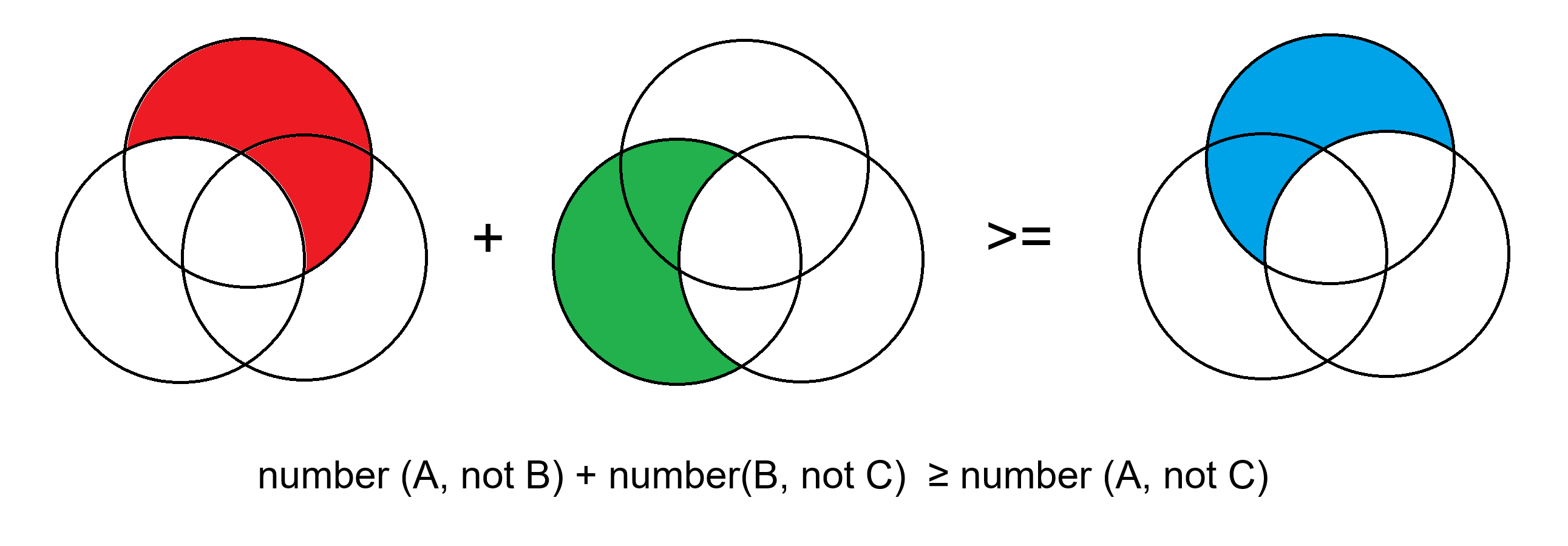
Bell's Inequality, shown in pictoral form here as Venn diagrams, allowed resolution of the EPR paradox by experiment, because it showed how to assess three measurements of quantum spin, against three assumptions of physics: The following A,B,C through 1,2,3, were taken from and explanation made by David M. Harrison of the University of Toronto.
The Venn diagrams to the right show circles for A, B, and C, where:
- A: electrons are 'spin-up' for an 'up' being defined as straight up, which we will call an angle of zero degrees.
- B: electrons are 'spin-up' for an orientation of 45 degrees.
- C: electrons are 'spin-up' for an orientation of 90 degrees.
The logic of Bell's inequality is illustrated by the Venn diagram, which shows A not B + B not C >= A not C
We make two assumptions to derive Bell's inequality which here become:
- - Logic is valid.
- - Electrons have spin in a given direction even if we do not measure it.
Now we can add a third assumption in order to beat the Uncertainty Principle:
- - No information can travel faster than the speed of light.
We will state these a little more succinctly as:
- 1. Logic is valid.
- 2. Realism - there is a reality separate from its observation.
- 3. Locality - the speed of light cannot be exceeded.
Then, if the inequality is shown to be false, we know that at least one of the original assumptions is incorrect, and it seems that Realism, and with it EPR, is the likely casualty, as the experiments did indeed break the inequality.
Spinoza attempted to root his metaphysics in logic, and Bell laid logic on the table alongside realism and locality, in such a way that one of these had to give when the trio was disproven by experiment. So, although it seems a crazy question, should we doubt logic?
The one thing that we learn from Emergence, in my way of describing it, is that the way of the World is to allow the formation of novel things in response to paradox, i.e. that the impossible illogicality of paradox forces the birth of a resolution of paradox. We could retell this as Nature abhors a paradox, or that logic has creative power.
So, in Bell's test is there any inconsistency that refutes logic?
It seems to suggest that either c is not an impossible limit, or that hidden variables do not exist, or both, or c, the reason for locality, is simply not what we thought it was.
- Hidden variables - there is no evidence for extra properties that convey spin, and anyway, I was under the impression there was another proportion at work that denied the fixed quality of the hidden variable.
- Logic perhaps could force the emergence of some new thing - an entanglement as an object, whatever that would look like, but it appears a lot like magical thinking, or perhaps we should view it more as the emergence of a hidden variable.
- The speed of light is a function of distance and time, so locality is dependent on both factors, but if they really are emergent, then there is less problem invoking Bell on locality.
This third point is the argument that there is only Now, so locality is not an issue, what needs to be understood is why the instant exchange of a photon takes on the appearance of time passing, while the entanglement of spin, with an equally instant passage of information of entanglement, does not lead to time emerging.
The answer is that the photon subtracts energy from Alice, and imparts it to Bob; the photon is that process, and is instant, and quantum, but the classical effect is a Machian change to the balance of the Universe, so gravity occurs, and that looks like time. Old Alice appears to be in new Bob's past, while old Bob appears to be in new Alice's past. For entangled particles, the determination of spin changes nothing of the energy/mass of either particle, so the Universe does not change, and no time emerges.

Leave a Comment
Thank you!
Your comment has been submitted and is awaiting moderation.
Comments
No comments yet.
 Go Home
 To encourage the rapid completion of this content, please feel free to donate on
Patreon
To encourage the rapid completion of this content, please feel free to donate on
Patreon This page is /menu/answers/time.php and it was last updated on Thursday 9th of April 2026 08:47:44 AM